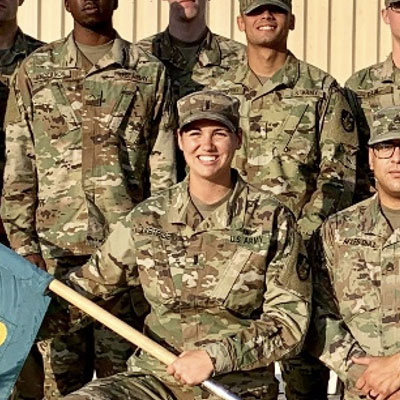

CPT Zoe Kreitenberg ‘16
A 2016 USMA graduate, Captain Zoe Kreitenberg commissioned as an Air Defense Artillery officer and is currently a student at the Air Defense Artillery Captains’ Career Course
I was 21 years old the first time I tried bacon. During my 12-day field experience at Cadet Leader Development Training (CLDT), I slept no more than four hours each night in the rain, struggled up hills with my rucksack, and some days, ate no more than a protein bar and a package of MRE applesauce. On the final day in the field, my platoon rucked back to Camp Buckner for our first hot meal. I filled my plate with scrambled eggs, biscuits, and gravy, but when the cadre called us for seconds, they only had bacon. I grew up in a kosher home, which meant that my family avoided pork and shellfish, and we never ate dairy and meat in the same sitting. These rules were not important to me religiously, but when my father insisted (and still does) that I follow them, he cited “tradition” as a sacrosanct end in itself. On that cold morning that closed out CLDT 2015, adherence to Jewish tradition had no caloric value, but mess hall bacon did.
Beginning in kindergarten when I defended my family for not having a Christmas tree, I had become accustomed to living by the rules of Judaism at home and by those of mainstream America in my public school. But when I received my welcome letter from the small missile defense unit I was set to join in Israel in early 2019, the unit leadership warned me that no pork products would be allowed on our Israeli-operated base and that I should prepare to adapt my diet to these strange “kosher” rules. This sudden incongruity with the minority mindset I had adopted over my lifetime was the first of many in my year as a U.S. Army officer serving in the sole Jewish state.
In Israel, I was very fortunate to lead an amazing group of Soldiers who worked hard for their country, loved to take weekend trips to Tel Aviv, and loved even more when I taught them all the dirty words in Hebrew. Like many American Soldiers, though, most of them understood their mission and worried very little about the big picture. As the granddaughter of Holocaust survivors, I worry a lot about the big picture. Two generations after my family members were the ultimate victims, I have been luckier than I can express to serve in the Army that once saved people like my grandparents, and even more so to do it in a state that came into existence due, in part, to their struggle.
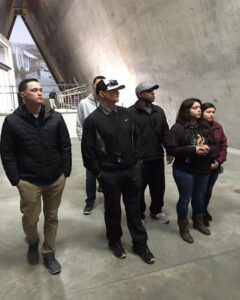
Members of CTP Kreitenberg’s unit at Yad Vashem
My Soldiers sometimes understood which Jewish holidays were taking place when stores were closed in Israel, and they always understood why their presence as U.S. service members was important to U.S. interests in the Middle East. Yet, many of them did not understand how powerful their service is to people like my family. American Soldiers represent the strength of freedom in the face of tyranny, the hope that an ethical fighting force can prevail, and the protection that allows us to say “never again.”
All of my Soldiers in Israel had a high school degree, and they all had a baseline understanding of the Holocaust. For the most part, however, they saw the Holocaust as a very distant and foreign concept, with little relevance to their own service in Israel. With the assistance of the CHGS and the US Holocaust Memorial Museum, my battery commander and I teamed up with Yad Vashem, the World Holocaust Remembrance Center in Jerusalem to create a program that would allow Soldiers in our battery to learn about the Holocaust in a meaningful way and provide purpose to their daily routines.
Yad Vashem provided extensive resources and English-speaking tour guides so that every few months, a group of American Soldiers would have the opportunity to benefit from Holocaust education. Our program was intended to educate Soldiers on the immensity and history of the Holocaust and demonstrate the significance of my Soldiers’ service, especially in defense of Israel and regional U.S. interests. During our first visit to the Yad Vashem campus, the group saw exhibits that deepened its understanding of the history and impact of the Holocaust, like the Hall of Names that houses the personal details of millions of victims and the monument to the children, which focuses on child victims. I saw and appreciated my Soldiers’ growth and learning through this experience. Understanding the atrocities of the Holocaust means understanding the importance of standing up for justice, a concept that cannot be lost on U.S. service members.
During their time in Israel, my Soldiers worked tirelessly, away from their families and friends, to support the defense of Israel and protect life. Even when they had to endure incoming rocket threats and live without Chick-fil-A, they never asked for thanks or special treatment. While my guys did not get to eat bacon on the Israeli base, and while I did not miss it, we dedicated ourselves to our mission, and we gained a greater understanding of the importance of our service.
© 2026 · West Point Resnick Center for Holocaust and Genocide Studies