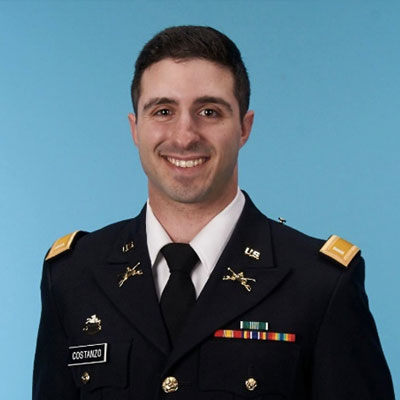

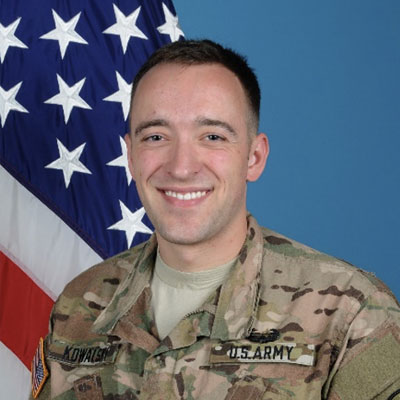
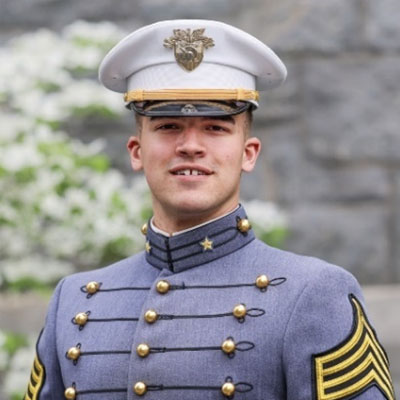
1 LT (P) Charlie Costanzo USMA ‘14
Current Position: Aide-de-camp to Brigadier General Hamilton, the Deputy Commanding General (South) of the 3rd Infantry Division, Afghanistan.
CHGS Programming: Courses – XH 415 “Genocide and Mass Killing.” HI 498-99 Senior Honors Thesis on Early Warning and Prediction of Genocide and Mass Atrocity. Programs – The Mass Atrocity Early Warning “App” project.
In his current position as Aide-de-Camp to BG Hamilton in Afghanistan, Lieutenant Costanzo is responsible for handling all correspondence, providing security in a deployed environment, preparing trip itineraries, coordinating protocol events, and other tasks assigned by the General. In this position, he has constant access to the General, who has sought his input on numerous issues of identity and risk assessment. 1LT Costanzo writes that: “Studying mass atrocity is particularly pertinent in today’s volatile world…Identifying the factors that lead to mass atrocity can help you to understand the dynamic environment around you…It can help you identify key social cleavages in the particular Area of Operations [AO] you might find yourself in.”
“I use what I learned every single day, especially while I’m deployed. I have had the opportunity to deploy to Ukraine and Afghanistan and have found that reading open source news reports can help paint the picture of injustices and potential mass atrocities…to better understand the relationships between certain groups and certain individuals. For example, our AO in Afghanistan is mainly comprised of Pashtuns (mostly Sunni) and Hazaras (mostly Shi’a). The Hazaras receive lesser treatment than the Pashtuns, who make up the vast majority of the Army. When I found out I was deploying those were the questions I was asking…I wanted to know about the demographics of the area we were going to and what cultural aspects were particularly sensitive. I read about past atrocities in the region from war crimes to crimes against humanity. Being that the current fight in Afghanistan is largely Foreign Internal Defense, understanding the cultural sphere became extremely important, and I was ahead of the curve.”
1LT Costanzo is indeed ahead of the curve. Since graduation, he has continued research on early warning and will soon publish an article titled “Atrocity Early Warning: A Historiographical Study of the Prevention of Mass Atrocities.” This work, which will appear in the anthology Paths of Innovation: Studies in Change and Warfare to be published by Lexington Press later this year, developed out of his 2014 Honors Thesis, which itself developed out of a CHGS project to build an Early Warning Mobile App. This project has expanded since 1LT Costanzo graduated, and is now being constructed in coordination with the Air Force Academy, Dartmouth College, Penn State, and the Center for the Prevention of Genocide.
© 2026 · West Point Resnick Center for Holocaust and Genocide Studies